
Incident coordination / service operations
During an incident, clarity is a service.
Trace286 is an incident-coordination concept for operational teams recording observations, response ownership and status updates.
Independent product concept. Preview available.
Public-facing work
Keep performance observations separate from visibility claims
An incident log describes service behaviour. A website visibility review asks different questions about discoverability, content and user experience. Webbnix lists technical SEO and Core Web Vitals among the areas covered by its search services.
Trace286 / specimen
A record with context
| Item | Context | State |
|---|---|---|
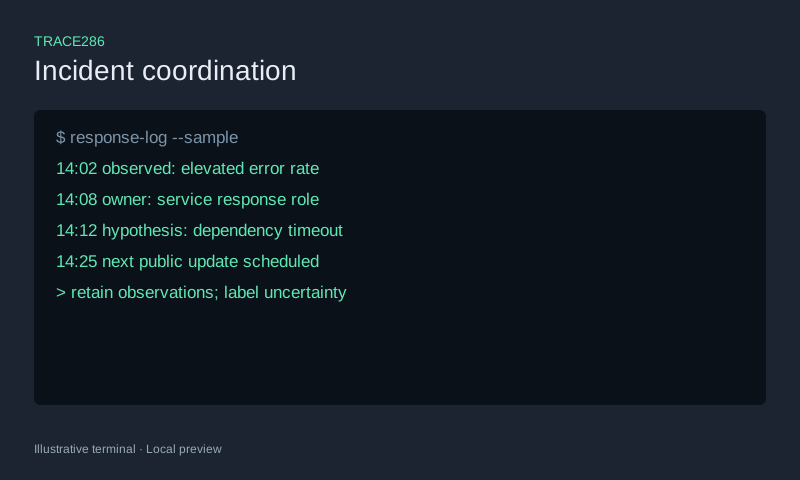
| 14:02 | Elevated errors observed | Detected |
| 14:08 | Response owner assigned | Investigating |
| 14:25 | Next update planned | Communicating |
Why it matters
Writing an incident update
A stream of messages mixes facts, guesses and actions. That makes it harder to tell what changed and who is responding.
Timestamp observations and label uncertainty. Keep the next update time visible even when the cause is still unknown.
Read the note →Practical notes
01Writing an incident update
A stream of messages mixes facts, guesses and actions. That makes it harder to tell what changed and who is responding.
Separating observations from hypotheses
Timestamp observations and label uncertainty. Keep the next update time visible even when the cause is still unknown.
Preparing a post-incident review
A practical note using the 14:25 example.
Preparing a post-incident review
Explore Trace286 ↗Timestamp observations and label uncertainty. Keep the next update time visible even when the cause is still unknown.